MES vs MOM - differences, functions & areas of application in comparison
Reading time: 4 min
Why Manufacturing Operations Management is the next evolutionary step in production management
Digital production systems are becoming increasingly complex. Real-time data, energy consumption, resource planning, logistics and quality indicators must be linked in order to operate modern factories in a stable, efficient and scalable manner.
Two central systems meet here: MES (Manufacturing Execution System) and MOM (Manufacturing Operations Management).
The two terms are often used interchangeably, although they are Different tasks and levels cover.
This article explains the structural difference between MES and MOM, shows which functions both systems perform - and why a clear distinction is important for every manufacturing organization.
What is an MES?
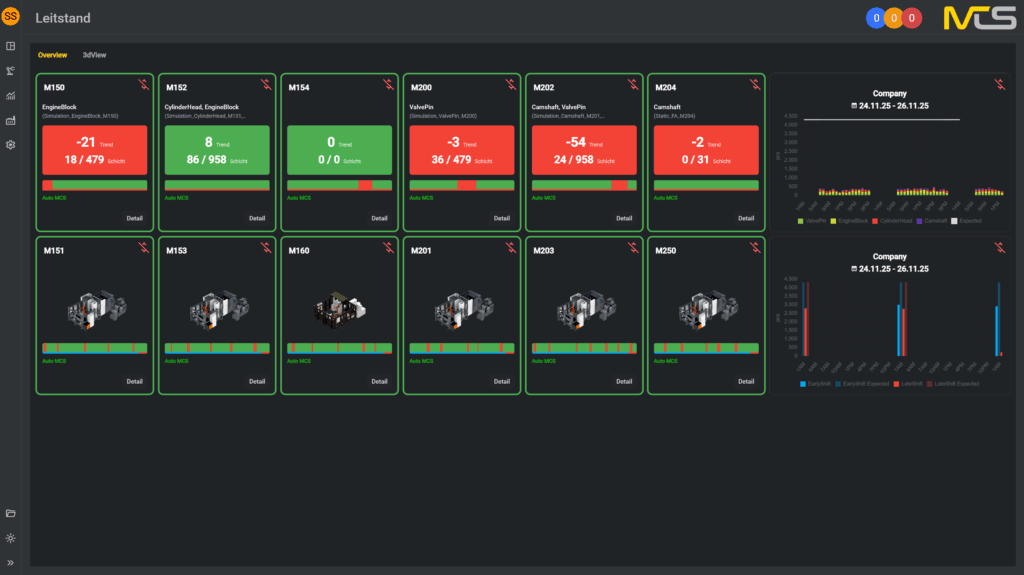
An MES (Manufacturing Execution System) is an operational software system for the Control, monitoring and evaluation of production processes in real time.
It connects machines, systems and employees on the store floor and ensures that production processes are transparent, stable and efficient.
The focus is on the Execution production - not the higher-level planning.
Typical functions of an MES:
- Production data acquisition (PDA)
- Machine data acquisition (MDE)
- Quality management
- Traceability / Traceability
- Control center / detailed planning
- Order and material tracking
Short: An MES optimizes processes directly on the store floor and creates operational transparency.
You can find a detailed explanation of the MES modules in our article on MES software.
What is MOM?
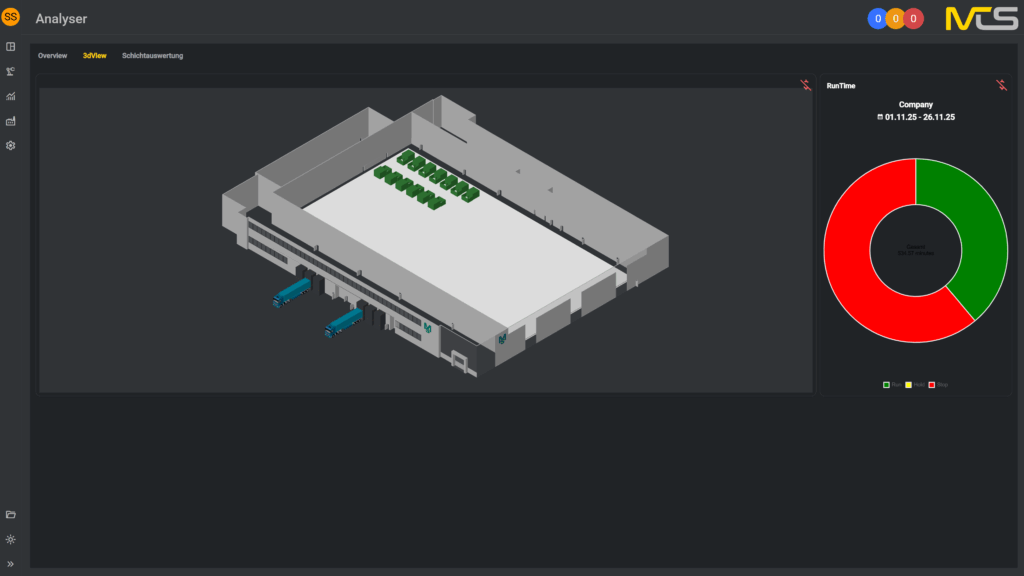
MOM (Manufacturing Operations Management) describes a holistic management approach, that goes beyond the operational production level.
A MOM fully encompasses an MES, but extends it to include planning, resource management, energy and logistics processes as well as analysis functions.
MOM thus forms the Production management level including strategic and tactical tasks.
Typical extensions of a MOM:
- Resource and shift planning
- Advanced production and capacity planning
- Energy data acquisition and energy monitoring
- Control and integration of intralogistics systems
(AGV, AGV, AMR or manual transportation) - KPI analysis, key figure systems and production analyzers
- Holistic work plan for logic, workflows and process control
- Close integration with ERP, OT and automation systems
Short: MOM = MES + planning + resource management + energy + intralogistics + analysis.
MES vs MOM - the most important differences
| Criterion | MES | MOM |
| Definition | System for real-time control and monitoring of production processes | Holistic management approach for the entire production organization |
| Focus | Operational execution on the store floor | Strategic & operational production management |
| Typical range of functions | BDE, MDE, quality, control center, traceability | MES + planning, resource management, energy, intralogistics, KPI analysis |
| Operational level | Plant level (store floor) | Plant and company level |
| Objective | Efficient production execution | Holistic optimization and end-to-end system integration |
| Integration | Must be connected (ERP/OT) | Is a core component of the IT/OT architecture |
| Classification | Part of the MOM | Superordinate term, fully encompasses MES |
When is an MES enough - and when do you need MOM?
An MES makes sense when...
- only individual store floor processes are to be digitized
- Machine and operating data must be recorded
- Transparency at plant level is sufficient
- Quality or traceability requirements must be met
MES is ideal when the focus is clearly on the operational production control lies
A MOM is useful if...
- the complete production organization holistic should be considered
- not only production, but also Planning, resources, energy and logistics must be integrated
- Intralogistics systems (AGV/AGV/AMR or manual transports) are part of the process
- data-based KPI analyses are to be used for optimization
- a Future-proof system established as a central platform in the company's IT environment.
- multiple locations, complex value streams or high levels of automation are required
A MOM is therefore the Consistent further development of a classic MES - and therefore the right choice for companies that require comprehensive transparency, integration capability and automation.
Why MOM is crucial in modern production management
In increasingly digitalized manufacturing landscapes, simply recording store floor data is no longer enough. Companies need systems that:
- several technologies (ERP, automation, intralogistics, energy, planning),
- Decisions based on data,
- Recognizing resource bottlenecks early on,
- Material and transport flows dynamically,
- and Company-wide KPIs consolidate.
A MOM fulfills precisely these requirements - and supplements the MES with the strategic perspective that has become indispensable for modern smart factories.

Concluding classification: MES as the backbone, MOM as the brain of production
MES ensures operational stability.
MOM provides holistic intelligence.
Or to put it another way:
MOM = MES + planning, resource management, energy data, intralogistics and KPI analysis.
Those who not only want to digitize their production, but also actively optimize, automate and Designing for the future If you want a MOM solution, there is no way around it.
How MCS connects both worlds
Our MCS - Matrix Control System - is a modern MOM platform, which provides a complete MES integrated and additional high-performance modules for Planning, Resource management, Energy monitoring, Intralogistics and KPI analysis provides.
Thanks to its modular architecture MCS adapts flexibly to the individual requirements of your company - regardless of whether you want to start with an MES or implement the complete MOM approach directly. For companies that want to scalable, sustainable and consistent solution for their production, MCS is the ideal choice.
Outlook
The consistent differentiation between MES and MOM forms the basis for a structured and digitally managed production operation. The next step is to embed this data, processes and decisions in an overarching overall concept: the Smart Factory.
In the digital factory, systems, machines, sensors and software interlock seamlessly. Production processes are becoming more networked, more transparent and increasingly self-optimizing. In combination with advanced automation, MOM is becoming a central component of the smart factory.
In the next article, we will show you how a smart factory is structured, the technologies behind it and how companies are progressing step by step on the path to digital production.
Next post: „Smart factory explained simply: how the digital factory works“